

2025-12-07
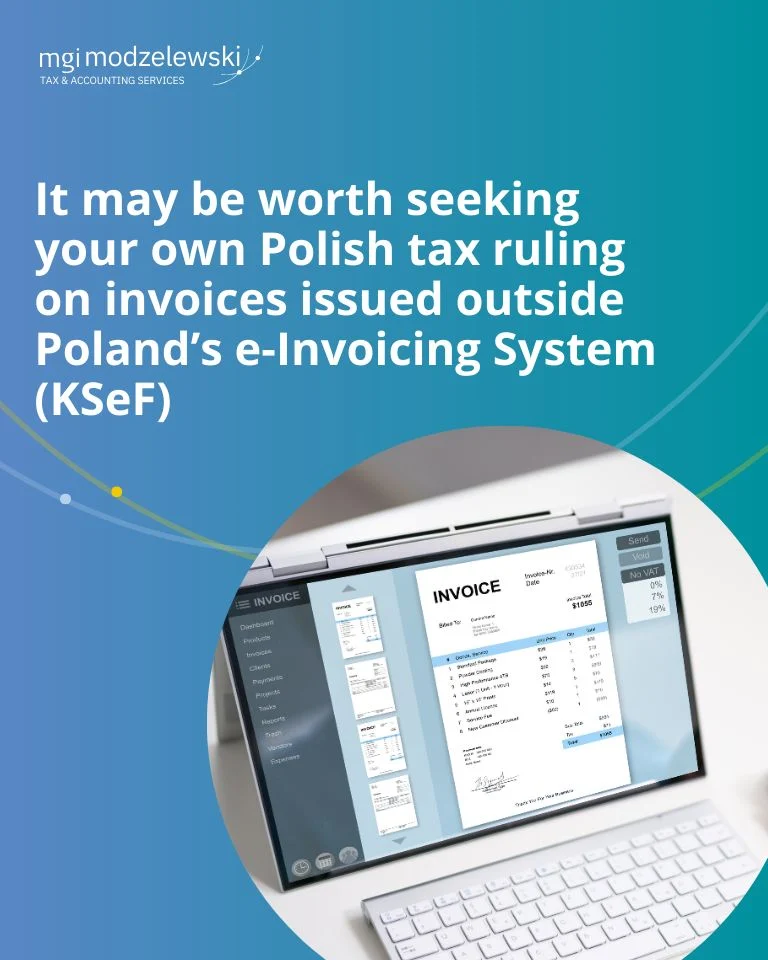
It may be worth seeking your own Polish tax ruling on invoices issued outside Poland’s e-Invoicing System (KSeF)
Even though penalties for issuing invoices outside Poland’s National e-Invoicing System (KSeF) have been deferred until 1 January 2027, the real headache may come sooner.
In 2026, plenty of “traditional” invoices (e.g., PDFs sent by email) will likely still be in circulation in Poland – some due to lack of awareness, some because of a misinterpretation of the rules, and some simply out of habit. For buyers, that’s not just an operational nuisance; it can also create Polish tax exposure.
In practice, a buyer may be left without clear answers to two basic questions:
• Why wasn’t the invoice submitted to Poland’s KSeF?
• Does it still allow the buyer to deduct Polish VAT and/or treat the expense as tax-deductible for Polish CIT/PIT purposes?
The uncertainty is compounded by the monthly PLN 10,000 gross threshold for invoices issued outside KSeF. A seller loses the right to invoice outside KSeF starting with the invoice that pushes them over the limit. From a buyer’s perspective, it may be impossible to tell whether the invoice they received should already have been issued via KSeF or whether it still falls within the “allowed” threshold. Cross-border transactions add another layer of complexity—especially when the key issue is whether a foreign counterparty has a “fixed establishment” in Poland. That assessment is often not straightforward, and it’s easy to get wrong.
On the VAT side, some comfort comes from individual rulings issued by the Head of Poland’s National Tax Information (DKIS) (e.g. case 0114-KDIP1-3.4012.838.2024.1.MPA and 0114-KDIP1-3.4012.507.2025.1.JG). These indicate that VAT deduction may still be possible where the invoice reflects a genuine transaction connected with taxable activity – even if, in theory, it should have gone through KSeF.
That said, tax authority practice can be inconsistent. So where significant amounts are involved, purchases are recurring, or counterparties are “hard cases”, it may be sensible to apply for your own individual ruling to secure protection tailored to your specific activity in Poland.
The biggest open question remains Polish tax-deductible costs (CIT/PIT) – there is still no clear guidance from either DKIS or the Ministry of Finance. All the more reason to consider an individual ruling in your specific case.
See other articles
Poland’s Ministry of Finance has proposed to postpone fines for violating obligations existing under the Polish e-Invoicing System (KSeF) - until 1 January 2028. The proposal is intended to give businesses one more year to adapt their invoicing processes to the new requirements. It would not, however, postpone the obligation to use KSeF or remove the consequences of incorrect VAT reporting. Taxpayers therefore need to understand which breaches the proposed postponement would cover and the limits of that protection.

By 15th of October 2026, some taxpayers might be transferred to a different Polish tax office as from 1 January 2027. If so, theymust notify the head of their currently competent tax office. This requirement covers transfers “up” to a specialised tax office, transfers between specialised offices, and transfers “down” to a local tax office. Whether a transfer is required may depend on the taxpayer’s sales revenue. However, comparing the latest annual figures with the current threshold is not enough. Taxpayers must also establish whether they meet the conditions for coming under a particular office’s jurisdiction or for leaving it. For the First Mazovian Tax Office in Warsaw, transitional provisions must also be considered. The rules below concern tax office jurisdiction determined by reference to revenue.

Can a shareholder derive taxable income from receiving a claim that they will never be able to enforce? According to the Polish tax authorities, the answer is yes. It is sufficient for the claim to be transferred to the shareholder as part of the distribution of liquidation assets, even if the shareholder is also the debtor and the obligation is extinguished as a result of confusio. This position was presented by the Director of the Polish National Tax Information Service in an individual tax ruling dated 21 July 2026, ref. 0115-KDWT.4011.203.2026.2.DS. The ruling confirms the restrictive approach adopted by the Polish tax authorities: first, the shareholder receives the claim, and only then is it extinguished. According to the authority, the first stage alone is sufficient to give rise to taxable income.

Reform of Poland’s tax ruling system: five-year validity and centralisation of municipal tax rulings
Businesses engaged in distance selling often issue an invoice as soon as goods leave the warehouse. Where delivery is handled by a third-party carrier, however, the actual date on which the supply takes place may not yet be known. This raises the question of whether the seller may issue an invoice without specifying the date of supply and whether, once delivery has been confirmed, the missing date must be added by means of a corrective invoice. These issues were addressed by the Director of Poland’s National Revenue Information Service (KIS) in an individual tax ruling dated 14 July 2026, reference no. 0114-KDIP1-2.4012.236.2026.2.RM. The ruling may be particularly relevant to businesses operating in the e-commerce, manufacturing and logistics sectors, especially where deliveries take place around the end of a VAT reporting period.

Reform of Poland’s tax ruling system: five-year validity and centralisation of municipal tax rulings
Poland’s Ministry of Finance is preparing a comprehensive reform of the rules governing the issuance and operation of tax rulings. Draft Bill UD445 provides, among other things, for a five-year validity period for individual tax rulings, a procedure for extending their protective effect, broader protection covering tax consequences arising before a ruling is served, and new grounds on which existing rulings may cease to apply. Draft Bill UD450, in turn, would transfer responsibility for issuing rulings on taxes and charges administered by municipal tax authorities to the Director of the National Tax Information Service. Not all elements of the reform are at the same stage of the legislative process. Draft Bills UD445 and UD450 have not yet been enacted. However, legislation requiring municipal tax rulings to be published in the central EUREKA tax rulings database has already been adopted. When assessing the implications of the reform, it is therefore important to distinguish between enacted measures and legislative proposals whose final wording may still change.
Poland’s draft bill UD116 could significantly change the tax treatment of certain entrepreneurs operating under B2B arrangements. The proposed rules would not abolish self-employment or Poland’s lump-sum tax regime on recorded revenue. However, they are intended to reduce the tax attractiveness of certain structures, particularly transactions with related parties, service businesses operating without employees, and the use of the Polish IP Box regime.

The Act of 29 May 2026 amending the Polish Tax Ordinance and certain other acts, signed by the President of Poland, introduces significant changes to the Polish rules on reporting tax schemes, commonly referred to as MDR, or Mandatory Disclosure Rules. The new MDR provisions are expected to enter into force on 1 October 2026 and will substantially narrow the scope of obligations which, since 2019, have been one of the more demanding elements of tax compliance in Poland.

Tax proceedings in Poland should not be a process in which only the tax authority decides which facts will be examined and which evidence will be taken into account. Under the Polish Tax Ordinance Act, taxpayers have the right to actively participate in proceedings, including the right to submit their own requests for evidence. In practice, however, not every piece of evidence proposed by a taxpayer will be admitted. When can the tax authority refuse an evidentiary request, and what options are available to taxpayers in such situations?

Determining when a VAT liability arises in relation to services remains one of the more challenging issues in practice under Polish VAT law. Although Article 19a(1) of the Polish VAT Act clearly states that VAT becomes due when a service is performed, establishing when a service is actually “performed” sometimes requires a case-by-case assessment of the contractual model and the underlying commercial reality. Recent Polish judgment by the Supreme Administrative Court of 31 March 2026 (I FSK 1353/23) provides important clarification in the context of IT services.
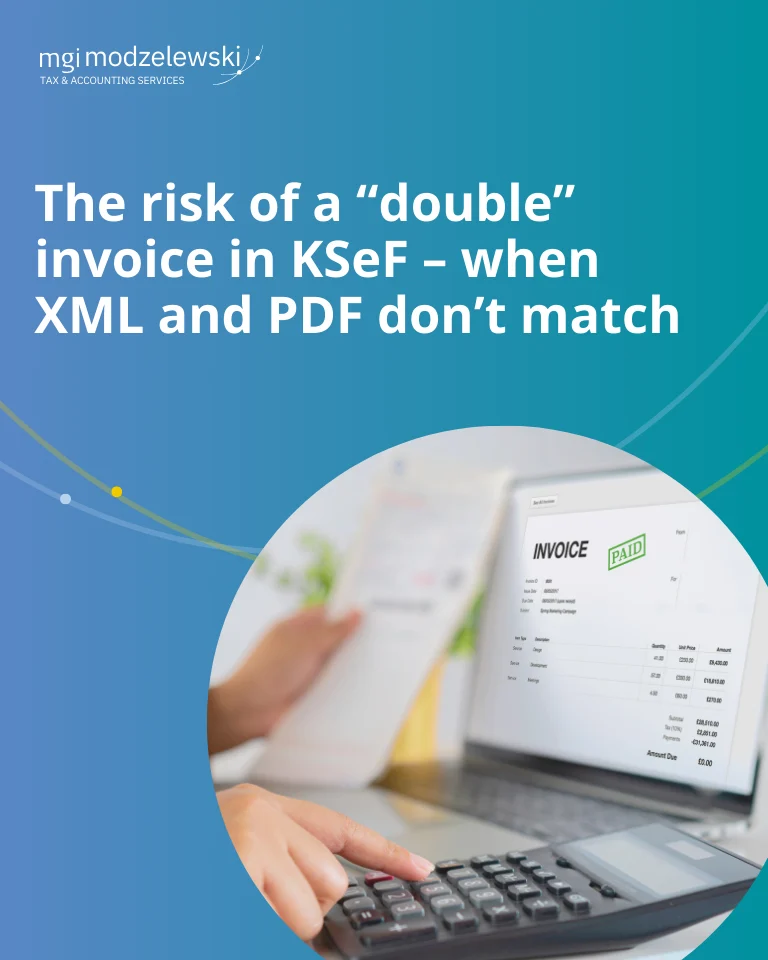
As the Polish National e-Invoicing System (KSeF) becomes more widely used, businesses are increasingly encountering a practical issue known as the “double document circulation.” This occurs when the structured invoice stored in KSeF (XML) differs from the PDF visualization sent to the customer, for example by email or through a customer portal.